How To Tell If a Texas Snake Might Be Venomous
The safest way to identify a snake is from a distance.
That may sound obvious, but it is worth saying plainly. If you have to lean in, poke it, move closer, or try to see the shape of its eyes, you are already too close.
Texas has a lot of snakes, and most of them are not venomous. Many are helpful around the property because they eat rodents, insects, and other pests. But Texas also has venomous snakes that homeowners should know about, especially if they spend time gardening, clearing brush, walking dogs, working around sheds, or letting kids play outside.
Texas Parks and Wildlife says the venomous snakes found in Texas include pit vipers — rattlesnakes, copperheads, and cottonmouths — along with coral snakes. The agency also reminds Texans that not every snake is venomous and that snakes play an important role in the ecosystem, especially by helping control rodents. You can read more from Texas Parks and Wildlife here: https://tpwd.texas.gov/education/resources/texas-junior-naturalists/snakes-alive/venomous-texas-snakes
The goal is not to turn every homeowner into a snake expert. The goal is to know enough to stay calm, keep your distance, and avoid making a dangerous mistake.
Look for a Rattle, But Do Not Depend on Hearing One
A rattlesnake is one of the easier venomous Texas snakes to recognize, at least in theory.
Many rattlesnakes have a rattle at the end of the tail, and some will shake it as a warning when they feel threatened. In Texas, rattlesnakes are part of the pit viper group, along with copperheads and cottonmouths.
But here is the important part: do not rely on the rattle as your only warning.
A rattlesnake may not rattle before striking. The rattle may be damaged. The sound may be hard to hear if there is wind, traffic, a lawn mower, or barking dogs nearby. Young rattlesnakes may also have very small rattles that are not obvious from a distance.
If you see a thick-bodied snake with a blunt tail, dark bands near the tail, or diamond-like markings along the back, treat it with caution. You do not need to confirm every feature. You need to back up and give it room.
Texas Parks and Wildlife has a venomous snake safety page that explains pit vipers and their features here: https://tpwd.texas.gov/education/resources/texas-junior-naturalists/be-nature-safe/venomous-snake-safety
Be Careful With the “Triangular Head” Rule
Many people have heard that venomous snakes have triangular heads.
There is some truth behind that idea with pit vipers. Rattlesnakes, copperheads, and cottonmouths often have broader, more triangular-looking heads compared with some nonvenomous snakes.
But this rule is not foolproof.
Some harmless snakes can flatten their heads when they feel threatened, making themselves look more triangular than usual. On the other hand, coral snakes are venomous and do not have the same large triangular head that people associate with pit vipers.
So yes, a broad triangular head can be a warning sign. But it should not be your only test.
A better rule is this: if you cannot confidently identify the snake from a safe distance, assume it may be dangerous and leave it alone.
Pit Vipers Have Heat-Sensing Pits, But You Should Not Try To See Them
Texas Parks and Wildlife explains that pit vipers have an opening on each side of the head between the eye and the nostril. Those openings help the snake detect heat.
That is where the name “pit viper” comes from.
In Texas, pit vipers include rattlesnakes, copperheads, and cottonmouths. Knowing that can help people understand snake identification, but it should not become a reason to get close.
If you are near enough to study the side of a snake’s face, you are too close. That detail is more useful in a field guide than in a real-life yard encounter.
For homeowners, the practical takeaway is simple. A heavy-bodied snake with a broad head, vertical-looking pupils, and a defensive posture may be a pit viper. But you do not need to prove it. Back away slowly and leave the snake alone.
Copperheads Blend In Better Than People Expect
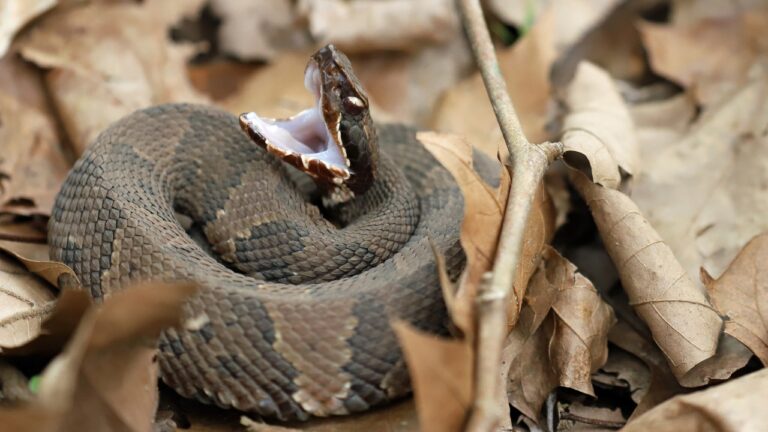
Copperheads are one of the snakes Texans need to watch for because they can be so hard to spot.
They are often tan, copper, or light brown with darker hourglass-shaped bands across the body. In leaves, mulch, rocky ground, or brush, that pattern can blend in beautifully.
That camouflage is part of the danger.
A copperhead may be lying still near a woodpile, along a shaded garden edge, or in leaf litter where a person does not notice it until they are too close. Copperheads are not usually trying to chase people, but they can bite if stepped on, grabbed, or cornered.
Texas A&M AgriLife identifies copperheads as one of the main groups of venomous snakes in Texas, along with rattlesnakes, cottonmouths, and coral snakes. Their overview of venomous Texas snakes is here: https://stories.tamu.edu/news/2010/08/12/venomous-snakes-of-texas/
When working in areas with leaves, mulch, brush, or stacked materials, use gloves, wear closed-toe shoes or boots, and look before putting your hands anywhere you cannot see.
Cottonmouths Are Often Near Water, But Not Every Water Snake Is One
Cottonmouths, also called water moccasins, are venomous pit vipers that are commonly associated with water.
Texans may see them near ponds, creeks, marshes, lakes, drainage ditches, or low wet areas. Adult cottonmouths can be heavy-bodied and dark-colored, and they are known for the pale white inside of the mouth they may show when threatened.
That mouth display is where the name “cottonmouth” comes from.
But there is a catch. Many harmless water snakes are mistaken for cottonmouths. Nonvenomous water snakes can look defensive, flatten their heads, and act intimidating when they feel threatened.
That is why guessing can be risky both ways. You do not want to treat a venomous snake casually, but you also do not want to kill every water snake just because it startled you.
The safe approach is to keep your distance, take children and pets away from the area, and let the snake move on. If it is too close to the house, pool, dock, or a busy yard area, call animal control or a trained wildlife removal professional.
Coral Snakes Look Bright, But They Are Still Easy To Misjudge
Coral snakes are different from rattlesnakes, copperheads, and cottonmouths.
They are not pit vipers. They are usually more slender and are known for bright red, yellow, and black bands. Texas Parks and Wildlife notes that coral snakes are the only venomous snakes in Texas with bright red, yellow, and black bands completely encircling the body.
You can read that Texas Parks and Wildlife snake identification guidance here: https://tpwd.texas.gov/education/hunter-education/online-course/preparation-and-survival/snakes
A lot of people know the old rhyme about red touching yellow. But rhymes can be misremembered, lighting can be poor, and similar-looking nonvenomous snakes can cause confusion.
The better advice is more direct: if you see a red, yellow, and black banded snake in Texas and you are not absolutely sure what it is, do not touch it.
Coral snakes are generally secretive, but venomous still means venomous. Leave them alone.
Behavior Can Help, But It Is Not a Guarantee
Some snakes give warning signs when they feel threatened.
A rattlesnake may rattle. A cottonmouth may open its mouth. A snake may coil, flatten its body, vibrate its tail, or try to escape. Those behaviors tell you the snake is stressed and wants space.
But behavior is not a perfect identification tool.
Nonvenomous snakes may act dramatic when scared. Venomous snakes may stay still and quiet. A snake that appears calm can still bite if someone gets too close.
That is why “it did not act aggressive” is not a safe reason to approach one.
Most snakes want to avoid people. Give them that chance.
Do Not Handle a Snake Even If It Looks Dead
This is one of the most important safety points.
The CDC’s National Institute for Occupational Safety and Health warns people not to pick up a snake or try to trap it. The agency also says never to handle a venomous snake, not even a dead one or its decapitated head. That CDC guidance is here: https://www.cdc.gov/niosh/outdoor-workers/about/venomous-snakes.html
That may sound extreme until you understand the risk. A snake can still cause injury after death due to reflexes, and trying to handle or kill a snake is one of the ways people get bitten.
If you find a snake in the yard, back away. If it is inside the house or trapped somewhere dangerous, call for help.
What To Do If You Cannot Identify the Snake
Here is the wise homeowner answer: you do not have to identify it.
You only have to respond safely.
Move children and pets away. Do not reach toward it. Do not throw things at it. Do not try to pin it down with a shovel. Do not crowd it for a better photo. Give it a clear escape route if it is outside.
If you need a photo for identification, take it from far away and zoom in with your phone. Then contact a local wildlife professional, animal control office, county extension office, or another qualified source.
If the snake is in a garage, shed, pool area, porch, or near a doorway, professional removal is usually the safer choice.
If Someone Is Bitten, Treat It Seriously
If a venomous snake bite is possible, get medical help right away.
The CDC says not to wait for symptoms to appear. It also warns against cutting the wound, sucking out venom, applying ice, using electric shock, or using a tourniquet. Instead, the person should seek medical care immediately.
While waiting for help, keep the person calm and still, remove tight jewelry or clothing before swelling starts, and keep the bite area in a neutral position of comfort if possible.
Snakebite first aid is not the time for old myths. It is the time for emergency care.
Respect Is the Best Identification Tool
Texas homeowners do not need to be terrified of snakes.
They do need to respect them.
A rattlesnake, copperhead, cottonmouth, or coral snake can be dangerous, but most snake encounters do not have to turn into emergencies. The problem usually starts when people get too close, try to handle the snake, or assume they know what they are looking at.
The smartest habit is also the simplest one: give every unknown snake space.
In Texas, that is not fear. That is common sense.

Grady Howard contributes coverage on Texas public-interest stories, household costs, transportation, weather-related concerns, safety alerts, and consumer topics.
His reporting is built around practical context — what changed, why it matters, and what readers should pay attention to next.