The Most Dangerous Snakes in Texas and How To Identify Them
Texas has plenty of snakes, and most of them are not dangerous.
That is the first thing worth remembering. A snake in the yard, near the lake, or crossing a country road is not automatically a threat. Many Texas snakes are nonvenomous, and some are downright helpful because they eat rodents and insects.
But Texas also has venomous snakes, and homeowners, hikers, ranchers, gardeners, parents, and pet owners should know the difference.
According to the Texas Department of State Health Services, venomous snakes in Texas fall into two main categories: pit vipers and coral snakes. The pit vipers include rattlesnakes, copperheads, and cottonmouths. Coral snakes are different from pit vipers and are known for their bright red, yellow, and black bands.
That does not mean Texans need to panic every time something moves in the grass. It means we need to be careful, informed, and respectful of wildlife that can hurt us if we get too close.
Rattlesnakes Are the Ones Most Texans Think About First
When people think about dangerous Texas snakes, rattlesnakes usually come to mind first.
Texas has several kinds of rattlesnakes, including the western diamondback rattlesnake, timber rattlesnake, massasauga, Mojave rattlesnake, and others depending on the region. The western diamondback is one of the best-known venomous snakes in the state.
Rattlesnakes are pit vipers. Texas Parks and Wildlife explains that pit vipers have an opening, or pit, on each side of the head between the eye and nostril. Those pits help them detect heat. Pit vipers also tend to have triangular-looking heads and vertical pupils, though getting close enough to check a snake’s pupils is not a safe identification method.
The easiest clue with many rattlesnakes is the rattle at the end of the tail. But there is a catch: not every rattlesnake will rattle before striking, and some rattles may be damaged, missing, or hard to hear.
A western diamondback often has a heavy body, diamond-shaped markings along the back, and black-and-white bands near the tail. If you see a thick-bodied snake with a rattle, give it space immediately. Do not try to scare it, move it, or kill it.
Texas Parks and Wildlife has a helpful overview of venomous snake safety and identification here: https://tpwd.texas.gov/education/resources/texas-junior-naturalists/be-nature-safe/venomous-snake-safety
Copperheads Can Be Hard To See
Copperheads are one of the venomous snakes Texans are most likely to run into around yards, wooded areas, creek beds, and leaf litter.
They are also easy to miss.
Copperheads are known for their camouflage. Their bodies often have tan, brown, or coppery coloring with darker hourglass-shaped crossbands. In leaves, mulch, or wooded areas, that pattern can blend in extremely well.
That is what makes them risky. Copperheads are not usually out looking for a fight, but a person can step too close without realizing the snake is there.
Texas A&M AgriLife notes that copperheads are one of the four main venomous snake groups Texans should know, along with rattlesnakes, cottonmouths, and coral snakes. You can read more from Texas A&M
Around a Texas home, copperheads may be found near woodpiles, brush, rocky areas, shaded garden beds, tall grass, or places where insects and small animals are active. They may also be more active in the evening or at night during hot weather.
The wise move is simple: watch where you step and where you put your hands. Use a flashlight after dark. Wear shoes outside. Be careful when picking up firewood, moving flower pots, or cleaning around shaded corners of the yard.
Cottonmouths Are Often Found Near Water
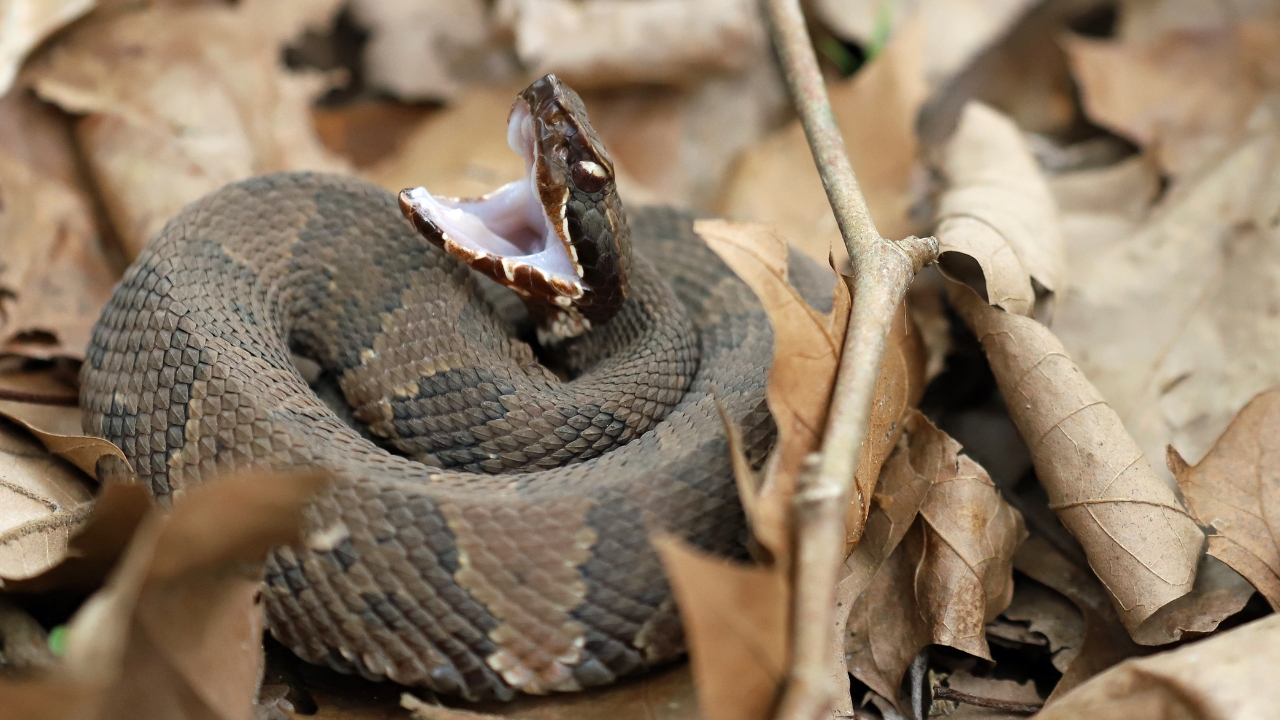
Cottonmouths, also called water moccasins, are another venomous pit viper found in Texas.
They are strongly associated with water, although they are not limited to it. Texans may encounter them near ponds, creeks, marshes, drainage ditches, riverbanks, lakes, and low wet areas.
Cottonmouths are usually heavier-bodied snakes. Their coloring can vary, but many adults appear dark brown, olive, or nearly black. One of their most famous warning signs is the white interior of the mouth, which they may show when threatened. That open-mouth display is where the name “cottonmouth” comes from.
That said, nobody should get close enough to rely on that feature.
One common issue in Texas is that harmless water snakes are often mistaken for cottonmouths. Many nonvenomous water snakes can flatten their heads, act defensive, and look intimidating when they feel threatened. That confusion leads to a lot of unnecessary fear.
Still, if you are near water and cannot confidently identify the snake from a safe distance, treat it as venomous and leave it alone.
Texas Parks and Wildlife’s snake safety guidance reminds people not to put their hands or feet where they cannot see and to be careful around areas where snakes may hide, including brush, logs, and rocks. That advice matters near water just as much as it does in the yard.
Coral Snakes Look Different From Other Venomous Texas Snakes
Texas coral snakes are venomous, but they do not look like rattlesnakes, copperheads, or cottonmouths.
They are not pit vipers. They are brightly colored snakes with red, yellow, and black bands that encircle the body. Texas Parks and Wildlife notes that coral snakes are the only venomous snakes in Texas with bright red, yellow, and black bands completely around the body.
You may have heard the old rhyme about red touching yellow. While the rhyme is familiar, it is not something to rely on everywhere or in every situation. Patterns can be confusing, lighting can be poor, and people can misremember the rhyme when they are startled.
The better rule is this: if you see a red, yellow, and black banded snake in Texas and you are not absolutely sure what it is, leave it alone.
Coral snakes are usually secretive and are not as commonly encountered as some other venomous snakes, but they still deserve caution. Do not pick one up. Do not try to handle one for a picture. Do not assume a small snake is safe just because it does not look bulky or aggressive.
Texas Parks and Wildlife has more on identifying Texas snakes, including coral snakes, here: https://tpwd.texas.gov/education/hunter-education/online-course/preparation-and-survival/snakes
The Most Important Identification Rule Is Distance
There are helpful clues Texans can learn: rattles, banding, body shape, head shape, camouflage, habitat, and behavior.
But the safest identification tool is distance.
If you have to get closer to identify a snake, you are already too close. A photo taken from a safe distance can help a professional identify it later, but no picture is worth a bite.
This is especially important for children and pets. Kids may be curious. Dogs may be bold. Cats may stalk anything that moves. Around snake country, curiosity can become dangerous quickly.
Teach kids not to touch snakes, even if the snake looks dead. Keep pets away from brush piles, woodpiles, tall grass, and snakes seen near patios or fence lines. If a snake is in an area where people or pets are likely to get too close, call animal control or a trained wildlife removal professional.
What To Do If Someone Is Bitten
If someone is bitten by a snake that may be venomous, treat it as an emergency.
The CDC’s National Institute for Occupational Safety and Health recommends laying or sitting down with the bite in a neutral position of comfort, removing rings or watches before swelling starts, washing the bite with soap and water, covering it with a clean dry dressing, and marking the leading edge of swelling or tenderness with the time written beside it.
The CDC also says not to try to capture or kill the snake, not to cut the wound, not to suck out venom, not to apply ice, and not to use a tourniquet.
You can read the CDC/NIOSH snakebite guidance here: https://www.cdc.gov/niosh/outdoor-workers/about/venomous-snakes.html
The Mayo Clinic also advises calling 911 or your local emergency number right away if a venomous snake bite is suspected, especially if the bitten area changes color, swells, or becomes painful. Their first-aid guidance is here: https://www.mayoclinic.org/first-aid/first-aid-snake-bites/basics/art-20056681
Texas Snake Safety Comes Down to Respect
The most dangerous snakes in Texas are not monsters. They are wildlife doing what wildlife does: hunting, hiding, moving, and defending themselves when they feel threatened.
Rattlesnakes, copperheads, cottonmouths, and coral snakes all deserve caution. But fear is not the same as wisdom.
Wisdom is wearing boots when walking through tall grass. It is using a flashlight at night. It is keeping the yard trimmed. It is teaching children not to touch snakes. It is leaving snakes alone when you see them. It is calling a professional when a snake is too close to the house.
In Texas, snakes are part of the landscape. The goal is not to live scared of them. The goal is to know enough to stay safe.

Arlie Howard contributes coverage on consumer issues, family-focused stories, household concerns, scams, local cost-of-living topics, and real-life situations that affect Texas readers.
Her work focuses on explaining what happened clearly and helping readers understand the details that may matter most.