Houston-Area Golf Course Says Hundreds of Invasive Ducks Have Taken Over the Property
At first, a few ducks wandering around a golf course probably sounded charming.
They waddled near the ponds. They crossed the cart paths. They made the place feel a little more peaceful and a little more alive.
Then a few ducks turned into hundreds.
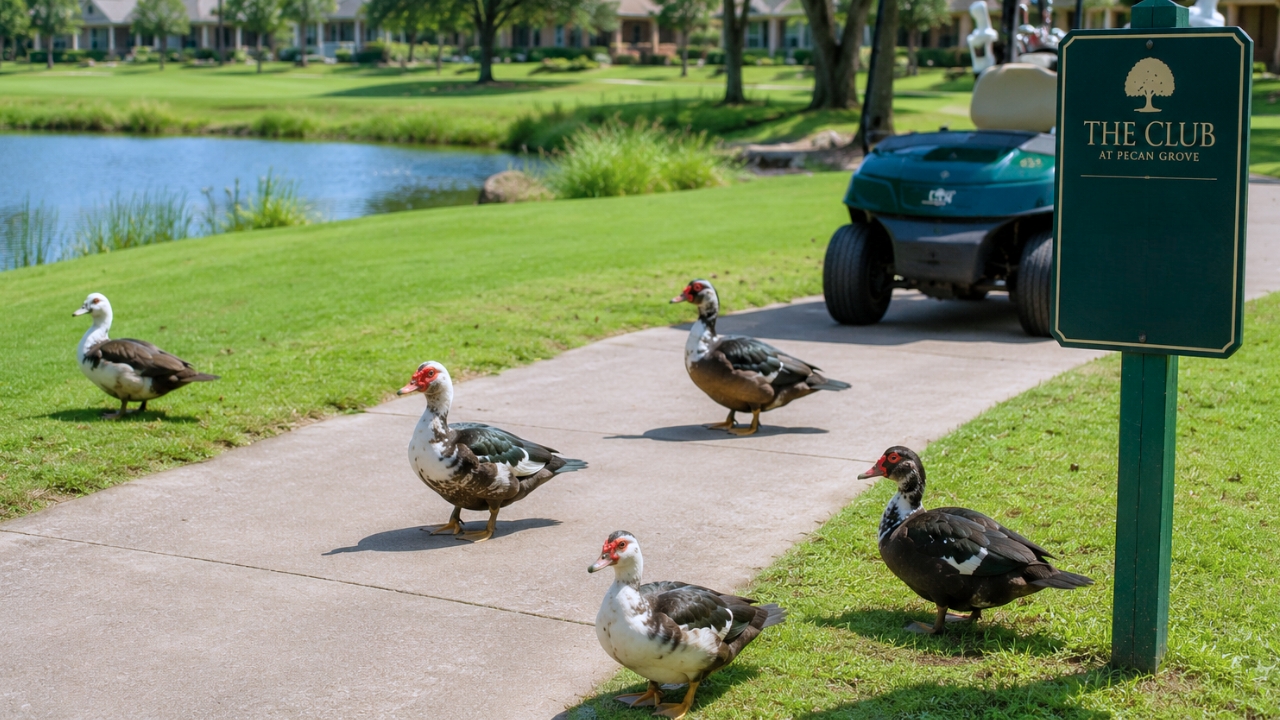
Now The Club at Pecan Grove in Richmond says it is dealing with roughly 400 Muscovy ducks, along with a growing number of Egyptian geese, and the birds have become much more than a cute background detail on the fairway.
According to Chron, club officials say the birds have overwhelmed parts of the semi-private golf course and nearby neighborhood. They are leaving droppings on sidewalks, cart paths, tee boxes, and gathering areas. They are also damaging turf, affecting water quality, and competing with native wildlife.
That is not exactly the relaxing golf-course atmosphere people are paying for.
Muscovy ducks are a tricky part of Texas wildlife conversations because they are not always treated the same way everywhere in the state. They are native to the Lower Rio Grande Valley in far South Texas, but outside that region they are often considered invasive because they multiply quickly and adapt easily to suburban places.
Golf courses are almost perfect for them.
There is water. There is open grass. There are people. And in some neighborhoods, there are residents who feed them, even when they are asked not to.
That feeding may feel harmless in the moment, especially when the birds look friendly or when baby ducks are following behind. But it can make the problem worse. Once ducks connect people with food, they stop keeping their distance. They gather in bigger numbers, return to the same spots, and become more comfortable crowding areas used by golfers and residents.
Chron reported that some golfers have mixed feelings about the situation. People think the baby ducks are cute, but many also admit the larger birds have become a mess around the course. That is the strange part of a story like this. The animals can be charming and still be a real problem.
Club officials said doing nothing was no longer responsible.
The Club at Pecan Grove has been working with wildlife professionals, local community groups, and Texas Parks and Wildlife on a management plan. According to the report, the club says it wants the plan handled humanely by licensed wildlife experts, with the goal of reducing the invasive bird population while following applicable laws.
That will probably not satisfy everyone.
Any time a community tries to remove animals, especially animals people see every day, emotions get involved. Some residents see the ducks as part of the neighborhood. Others see them as a health, property, and maintenance problem. Golfers may get annoyed when birds crowd tee boxes or leave messes on paths. Families may enjoy seeing them near the water.
Both reactions can exist at the same time.
The issue is not only about inconvenience. Large populations of non-native birds can change the balance around ponds and green spaces. Droppings can affect water quality. Turf damage can become expensive. Native birds may be pushed out. And when birds become used to humans feeding them, they can become more aggressive or harder to manage.
Egyptian geese add another layer to the problem. They are native to parts of Africa, but escaped or released birds have spread in parts of Texas, especially around urban ponds, golf courses, parks, and lakes. They are known for being loud, territorial, and comfortable living around people.
So what started as a pleasant wildlife sight has become a neighborhood headache.
That is the part that makes this such a Texas suburban story. A nice golf course. A growing wildlife problem. Residents split between “they are adorable” and “please get them off the tee box.” A management plan that is almost guaranteed to make someone unhappy.
For now, the ducks and geese are still part of daily life at Pecan Grove.
But the club says the population has grown too large to ignore, and officials are preparing to act.
Sometimes the weirdest neighborhood problem is not a crime, a storm, or a giant alligator in the road.
Sometimes it is 400 ducks acting like they own the place.

Arlie Howard contributes coverage on consumer issues, family-focused stories, household concerns, scams, local cost-of-living topics, and real-life situations that affect Texas readers.
Her work focuses on explaining what happened clearly and helping readers understand the details that may matter most.