A Barrel Racing Barn Attack Has Riders Asking: How Safe Are Horses Overnight at Big Shows?
A troubling case out of Las Vegas has put a hard question in front of rodeo families everywhere: when horses are stalled overnight at a big event, how safe are they really?
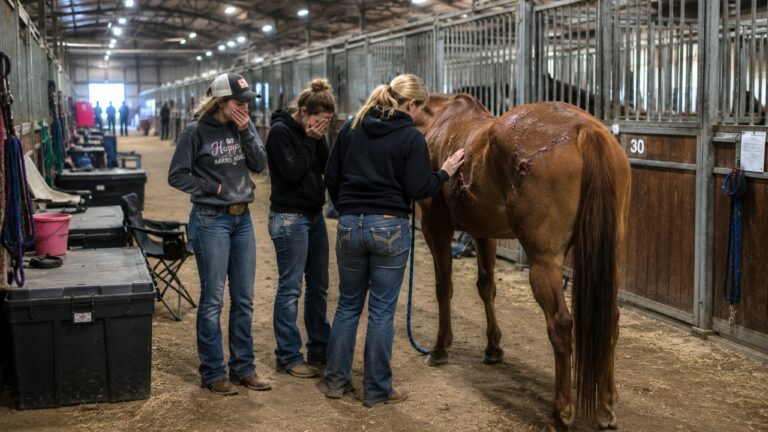
The question comes after police said three horses were intentionally injured during the 2026 National Barrel Horse Association Professional’s Choice Las Vegas Super Show. According to the Las Vegas Metropolitan Police Department, officers responded early Saturday, May 30, to a barn area in the 9700 block of South Las Vegas Boulevard after a horse was reported injured.
Police later said three horses had been intentionally hurt with a sharp object.
For people who do not live in the rodeo world, this may sound like a strange, isolated crime story. But for barrel racers, horse owners, parents, trainers, and anyone who has ever hauled to a weekend show, it touches a very real fear.
A horse show barn is supposed to be a safe place.
It is where riders cool down after a run, where parents check water buckets before bed, where horses are fed, brushed, wrapped, and settled in for the night. At a major event, barns can be busy almost around the clock. People are walking horses, hauling hay, checking stall cards, hauling tack, and getting ready for early runs.
That constant movement can make a show feel secure. But it can also make it harder to know who belongs in the barn and who does not.
Police said the suspect in the Las Vegas case was a teenage girl who had access to the barn. Investigators believe she may have used a knife to injure the animals. She was later found at a nearby hotel and taken into custody, according to police.
People reported that the teen was booked into Clark County Juvenile Hall on several counts, including animal cruelty-related charges and felony malicious destruction of private property.
The horses survived, but the injuries were serious enough to keep them from competing.
That detail matters. Barrel racing is not a casual backyard hobby for many families. It can involve years of training, expensive hauling, entry fees, stalls, hotel rooms, fuel, feed, farrier work, and veterinary care. A horse may be hauled hundreds or even thousands of miles for one event. By the time a rider arrives at a major show, a lot has already been invested before they ever enter the arena.
And then there is the emotional side.
A barrel horse is not just an athlete. It is a partner. Riders know how their horses breathe, how they warm up, how they react to pressure, and when something feels off. Many riders spend more time with their horses than they do with most people. So the idea of someone walking into a barn and intentionally hurting horses feels personal to the entire community.
The National Barrel Horse Association said the incident was isolated and addressed immediately with law enforcement, South Point security, and other appropriate parties. Fox 5 Las Vegas reported that the organization said there was no ongoing threat after the suspect was removed.
Still, this is the kind of case that makes people rethink their habits at shows.
In Texas, where barrel racing is part of the wider rodeo culture, plenty of families know the routine. You pull into fairgrounds or an arena late at night. You unload, get your stall ready, check the water, make sure the horse is settled, and hope for a few hours of sleep before the next day starts. At bigger events, riders often trust that the grounds, staff, and community culture will keep things under control.
Most of the time, that trust is deserved.
Horse people tend to watch out for each other. If a horse is loose, somebody grabs it. If a stall door is open, someone says something. If a horse looks colicky, sweating, injured, or tangled in a bucket strap, people notice fast.
But this case shows how quickly something can happen even in a place full of experienced horse people.
Now, riders may be thinking about extra stall checks, buddy systems, cameras, stricter access rules, and whether event grounds need more overnight security in barn areas. Some families may decide not to leave horses unattended as long. Others may start asking more questions before they haul to a major show: Who has access to the barns? Are there cameras? Is security walking through at night? Are competitors given wristbands, badges, or stall-area passes?
Those may sound like small details, but they matter when valuable animals are involved.
There is also a youth-sports angle here that makes the story even more uncomfortable. The suspect is a minor, and authorities have not publicly released her name. Because of that, the case has to be discussed carefully. She is accused, not convicted. The legal process still has to play out.
But the horses and their owners are already dealing with the aftermath.
The Guardian reported that the injured horses included horses named Detail, Rocket, and Sully, and that the wounds were not considered life-threatening but did force the animals out of competition.
For a barrel racer, being pulled from competition is disappointing. But finding out your horse was intentionally hurt is something else entirely.
That is the part Texas rodeo families understand immediately. You can lose a run. You can knock a barrel. You can have a bad draw, a muddy arena, a trailer problem, or a horse that just is not feeling right that day. Those things are part of the sport.
But an alleged attack inside a barn crosses a different line.
It turns a competition weekend into a safety concern. It turns a stall into a crime scene. And it leaves every rider wondering what they would have done if it had been their horse standing there.
The horses are expected to recover, according to reports. That is the best news in an awful situation. But the questions this case raises will probably last much longer than the show itself.
For barrel racing families in Texas and beyond, the lesson is not to panic. It is to pay attention.
Check the barn. Know who is around your horse. Talk to event staff. Report strange behavior. Keep stall areas as secure as possible. And remember that even in a tight-knit sport built on trust, safety still has to be taken seriously.
Arlie Howard contributes coverage on consumer issues, family-focused stories, household concerns, scams, local cost-of-living topics, and real-life situations that affect Texas readers.
Her work focuses on explaining what happened clearly and helping readers understand the details that may matter most.