The Harmless Texas Snakes People Often Mistake for Dangerous Ones
Not every scary-looking snake in Texas is dangerous.
That is worth remembering, especially when a snake shows up close to the house. Most people do not stop to calmly study scale patterns when something suddenly moves beside the porch, under the flower bed, or across the driveway. They see a snake, they get startled, and their mind jumps straight to rattlesnake, copperhead, cottonmouth, or coral snake.
That reaction is understandable.
Texas has venomous snakes, and homeowners should take snake safety seriously. But Texas also has many nonvenomous snakes that are commonly mistaken for dangerous ones. Some are harmless water snakes. Some are rat snakes. Some are kingsnakes. Some are brightly colored snakes that make people think of coral snakes.
The Texas Parks and Wildlife Department notes that Texas is home to many snake species, but only a smaller group is venomous. TPWD lists rattlesnakes, copperheads, cottonmouths, and coral snakes as the venomous groups Texans should recognize, while also reminding people that snakes play an important role in controlling rodents and other pests. You can read TPWD’s overview here: https://tpwd.texas.gov/education/resources/texas-junior-naturalists/snakes-alive/venomous-texas-snakes
The safest rule is still simple: if you cannot identify a snake from a safe distance, leave it alone. But knowing a few commonly misidentified snakes can help Texas homeowners respond with more caution and less panic.
Texas Rat Snakes Are Often Mistaken for Rattlesnakes
Texas rat snakes can make people nervous because they are large, quick, and sometimes defensive when startled.
They may climb trees, fences, walls, sheds, and even parts of a home. Around a Texas property, they may show up near barns, garages, chicken coops, woodpiles, brush, or places where rodents are active.
Rat snakes are nonvenomous. They help control rats and mice, which makes them useful around farms, ranches, and neighborhoods. But when they are surprised, they may coil, strike, or vibrate their tail in dry leaves. That tail vibration can sound a lot like a rattlesnake to someone who is already nervous.
That is where the confusion starts.
A rat snake does not have a true rattle, but if its tail is buzzing against leaves, mulch, or debris, the sound can fool people. Add a long body and a defensive posture, and many homeowners assume the worst.
The University of Texas at Austin’s Biodiversity Center has information on Texas snakes, including nonvenomous species such as rat snakes, here: https://biodiversity.utexas.edu/news/entry/snakes-of-texas
The best response is still distance. A rat snake may not be venomous, but it can bite if handled or cornered. Let it move along, especially if it is outdoors and not threatening anyone.
Plain-Bellied Water Snakes Are Often Mistaken for Cottonmouths
Any snake near water tends to get called a water moccasin.
In Texas, that is not always correct.
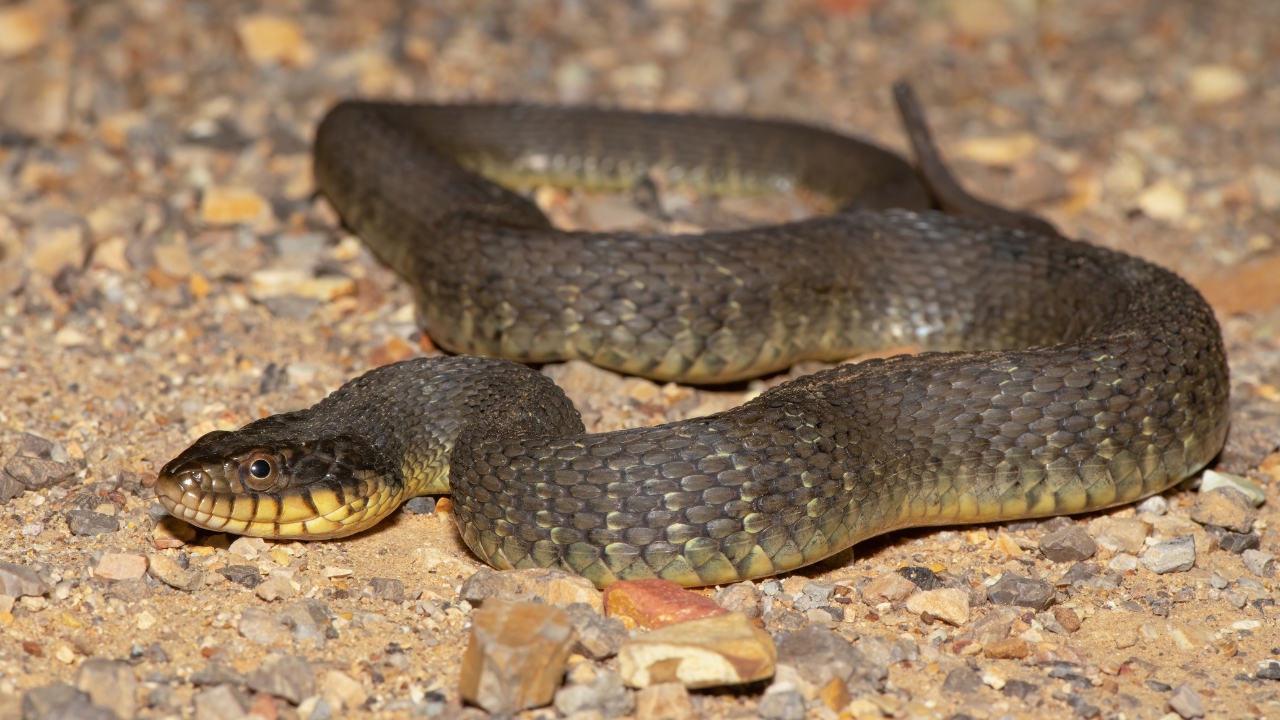
Plain-bellied water snakes and other nonvenomous water snakes are often mistaken for cottonmouths because they live around ponds, creeks, lakes, marshes, drainage ditches, and other wet areas. They can be thick-bodied, defensive, and quick to flee into the water.
When threatened, some water snakes flatten their heads or bodies, making themselves look more intimidating. To a homeowner walking along a pond bank or cleaning around a drainage area, that can look close enough to a cottonmouth to cause alarm.
Cottonmouths are venomous and should be respected. But many harmless water snakes are killed because people assume every dark snake near water is dangerous.
Texas Parks and Wildlife’s snake safety page explains that cottonmouths are one of Texas’ venomous pit vipers and are commonly associated with water. That guidance is available here: https://tpwd.texas.gov/education/resources/texas-junior-naturalists/be-nature-safe/venomous-snake-safety
If you see a snake near water and are not sure what it is, do not move closer to check. Back away, keep pets out of the area, and let the snake leave.
Diamondback Water Snakes Can Look More Dangerous Than They Are
The diamondback water snake is another nonvenomous snake that gets mistaken for something worse.
The name alone does not help. When people hear “diamondback,” they often think of rattlesnakes. Diamondback water snakes also have bold markings and can look heavy-bodied, especially when seen from a distance or partly hidden near water.
These snakes are not venomous, but they may act defensive if disturbed. Like other water snakes, they can bite if handled, and they may release a strong-smelling musk when threatened.
That behavior can make them seem aggressive, but they are usually trying to escape.
The Texas Parks and Wildlife Department’s online field guide includes information about Texas snake species and is a helpful place for homeowners who want to learn more about what they may be seeing around their property: https://tpwd.texas.gov/huntwild/wild/species/
The wise move is not to guess from five feet away. Give the snake space. Take a photo from a safe distance if needed. Let a qualified source help identify it.
Bullsnakes Are Often Mistaken for Rattlesnakes
Bullsnakes, also known as gopher snakes in some regions, are another harmless Texas snake that can put on a convincing show.
They are nonvenomous, but they can be large and loud when threatened. A bullsnake may hiss, flatten its head, coil, and vibrate its tail. If that tail is moving in dry grass or leaves, the sound can resemble a rattlesnake.
That defensive behavior is meant to scare predators away. Unfortunately, it also scares homeowners.
Bullsnakes are actually helpful because they eat rodents. In open country, grasslands, ranch areas, and rural parts of Texas, they can be valuable neighbors, even if they are not exactly welcome on the porch.
The National Park Service notes that bullsnakes are nonvenomous and may imitate rattlesnake behavior by hissing loudly and vibrating their tails when threatened. You can read more from the National Park Service here: https://www.nps.gov/romo/learn/nature/bullsnake.htm
Even though they are not venomous, do not handle them. A scared bullsnake can still bite. Let it move away on its own.
Hognose Snakes Can Look Dramatic but Are Usually Harmless to People
Hognose snakes are famous for acting.
When threatened, some hognose snakes may flatten their neck, hiss, strike with a closed mouth, roll over, and play dead. For someone who does not know what they are seeing, that performance can be alarming.
In Texas, hognose snakes are generally not considered dangerous to people. They are rear-fanged and may have mild venom used for prey, but they are not treated like the medically significant venomous snakes Texans are warned about, such as rattlesnakes, copperheads, cottonmouths, and coral snakes.
Their upturned snout helps them dig, and they are often associated with sandy or loose soils. They may eat toads and other small prey.
Texas Parks and Wildlife’s broader snake education materials are a helpful reminder that many snakes people encounter are not venomous and that snakes are part of a healthy ecosystem. TPWD’s snakes page is here: https://tpwd.texas.gov/education/resources/texas-junior-naturalists/snakes-alive
The important thing is not to test the snake. If a hognose is putting on a show, it is stressed. Back away and let it calm down.
Milk Snakes and Scarlet Snakes Are Often Confused With Coral Snakes
Bright colors make people nervous, and for good reason.
Texas coral snakes are venomous and have red, yellow, and black bands. Because of that, other red, black, and light-colored snakes can cause confusion.
Nonvenomous milk snakes and scarlet snakes may be mistaken for coral snakes by people who only remember that bright bands can be dangerous. Many Texans know the old rhyme about red touching yellow, but rhymes are easy to misremember, and relying on them in a startled moment is not ideal.
Texas Parks and Wildlife says coral snakes are the only venomous snakes in Texas with brightly colored red, yellow, and black bands completely encircling the body. Its snake identification information can be found here: https://tpwd.texas.gov/education/hunter-education/online-course/preparation-and-survival/snakes
The safest advice is simple: if you see a red, yellow, and black banded snake and you are not absolutely sure what it is, do not touch it.
Kingsnakes Are Often Mistaken for Something Dangerous
Kingsnakes can make homeowners nervous because some have bold patterns, and they may be found in places where people are already on alert for venomous snakes.
But kingsnakes are nonvenomous and can be beneficial. They eat rodents, lizards, other snakes, and in some cases even venomous snakes.
That does not mean you should pick one up. A kingsnake may still bite if handled. But if one is passing through the yard, it may be doing more good than harm.
The Texas Master Naturalist program notes that many snakes are beneficial, including those that help reduce rodent populations. You can learn more through Texas A&M AgriLife and Texas Master Naturalist resources here: https://txmn.tamu.edu/
If a kingsnake is outdoors and not in a dangerous spot, the best approach is to leave it alone.
Rough Green Snakes Can Startle Gardeners
A rough green snake does not look much like a rattlesnake, cottonmouth, or copperhead.
But it can still startle a gardener who suddenly sees a bright green snake in shrubs, vines, or flower beds.
Rough green snakes are slender, nonvenomous, and often associated with vegetation. They eat insects and other small prey. In many ways, they are the kind of snake a gardener should be glad to have around, even if the first sighting causes a jump.
Because they are thin and well-camouflaged in green plants, people may not notice them until they move. That surprise is usually the scariest part.
The safest response is the same: do not handle it, do not harm it, and let it move along.
Why Misidentification Matters
Misidentifying snakes can create problems in both directions.
If someone assumes a venomous snake is harmless, they may get too close and risk a bite. If someone assumes every snake is venomous, they may kill harmless snakes that help control pests.
Neither reaction is ideal.
Texas Parks and Wildlife and Texas A&M AgriLife both emphasize practical safety: keep the yard maintained, reduce hiding places, do not handle snakes, and give snakes room. Texas A&M AgriLife has a helpful guide on reducing snake encounters here: https://agrilifetoday.tamu.edu/2021/05/21/snakes-are-out-reduce-encounters/
A homeowner does not need to identify every species perfectly. But it helps to know that many frightening snake encounters involve animals that are not actually venomous.
What To Do When You Are Not Sure
When in doubt, treat the snake with caution and distance.
Move children and pets away. Do not touch it. Do not try to kill it. Do not get closer for a better look. If it is outdoors and has a safe way to leave, let it leave.
If the snake is inside the home, in the garage, near a doorway, in a shed, around a pool, or in a high-traffic area, call animal control or a trained wildlife removal professional.
If you want identification, take a photo from a safe distance and contact a local expert, wildlife professional, county extension office, or reputable snake identification resource.
Respect Beats Panic
Texas snakes are not all the same.
Some are venomous and should be taken very seriously. Others are harmless neighbors that help keep rodents and pests under control. The trouble is that fear can make them all look dangerous in the moment.
The best answer is respect.
Respect the venomous snakes enough to keep your distance. Respect the harmless snakes enough to let them do their job. Respect your own safety enough not to handle any snake you cannot identify with confidence.
In Texas, that kind of calm common sense will serve you better than panic every time.

Arlie Howard contributes coverage on consumer issues, family-focused stories, household concerns, scams, local cost-of-living topics, and real-life situations that affect Texas readers.
Her work focuses on explaining what happened clearly and helping readers understand the details that may matter most.