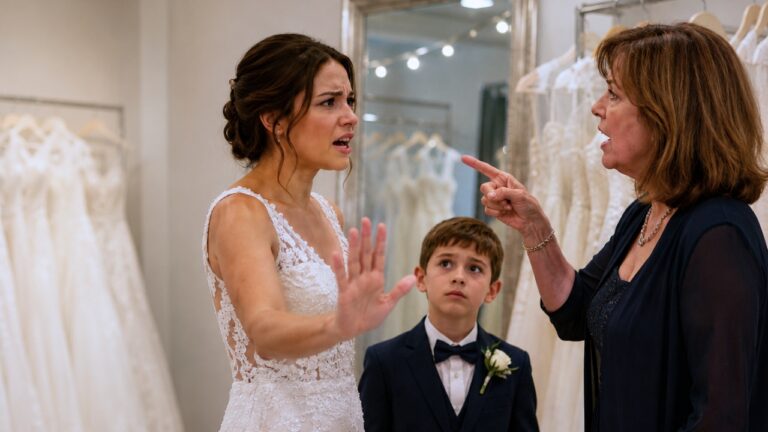
Dad Says His Fiancée Didn’t Want His 11-Year-Old Daughter in Their Wedding Because She Wouldn’t “Fit the Part”
A father says he was excited to marry the woman he had been with for five years, but wedding planning exposed a problem he could not ignore.
He was 45, divorced, and shared 50/50 custody of his 11-year-old daughter, whom he called P. He said his divorce from his ex-wife had ended on good terms, and he had remained an active father in his daughter’s life.
After that divorce, he met his fiancée, whom he called S.
For years, things seemed stable. S and his daughter got along well, at least as far as he could tell. The relationship lasted five years before he proposed, which meant S had known the girl since she was about six years old. This was not a brand-new relationship where everyone was still learning how to blend their lives together.
So when wedding planning began, the father assumed his daughter would naturally be part of it.
S was excited after the engagement and began looking at venues. She started talking about bridesmaids and then told him she wanted her niece to be the flower girl.
He had no problem with that.
But he said he wanted P to be a flower girl too.
That was when the mood changed.
According to the father’s Reddit post, S looked at him strangely and said she did not think his daughter would “fit the part.”
The comment immediately upset him.
It was not just that S had a different wedding-party idea. It was the wording. His daughter was not a distant cousin or a guest they barely knew. She was his child. If he and S married, P would be her stepdaughter. The idea that she somehow did not “fit” into the wedding felt like a warning sign.
He told S his daughter would be in the wedding.
S pushed back. She said the girls in the wedding were up to her, and P would not be one of them.
That was when he drew a hard line.
He told her that if his daughter was not in the wedding, there might not be a wedding at all.
The argument escalated, and he left. Instead of staying in the house and fighting, he took P out for ice cream.
That quiet moment with his daughter made the situation hit harder. P already knew they were getting married. She told him she thought she would look pretty in whatever dress S picked for her.
The father said that broke his heart.
His daughter was not demanding attention or trying to take over the wedding. She was simply assuming she would be included. She was picturing herself dressed up for the ceremony, trusting that the adults in her life wanted her there.
After that, he texted S and told her he would be staying at a friend’s house to think things over.
Then S’s mother got involved.
According to the post, his future mother-in-law texted him and said he was overreacting. She argued that his daughter did not have to be in the wedding and that he was wrong for threatening to cancel over it.
But the father did not see it as a small wedding disagreement.
To him, this was about whether his future wife accepted his daughter as part of his life. A wedding is not only a party. In a blended family, it can also be a public moment where the new family is acknowledged. Excluding his daughter from the ceremony, especially while including S’s niece, felt like more than a preference.
He asked Reddit whether he had taken things too far by saying he might cancel.
Then he posted an update.
After reading the reactions and taking time away, he went home to talk to S. When he pulled into the driveway, S’s mother was already there in her car. He went inside and found S sitting at the kitchen table.
He asked the question directly: why did P not “fit the part,” and why did S not want her in the wedding at all?
Her answer shocked him.
According to the update, S quietly told him she had hoped that after the wedding, he would become a “holiday visit only” dad. She said she did not want P in the wedding photos around the house because she did not expect the girl to be around much after they were married.
That changed the entire situation.
This was no longer about a flower girl role, a dress, or wedding aesthetics. S was admitting that she expected him to reduce his role in his daughter’s life after marriage. She had not merely wanted P out of the ceremony. She had imagined P being mostly out of their home and their day-to-day future.
The father said he stayed calm, took S’s hand, and removed the engagement ring.
S started to cry and said they should not end the marriage over it. She said she could change.
He told her the damage was already done.
He said he wanted her things moved out by the following week and that she could come get them when his daughter was not home. The house was in his name, though he said S could take the furniture she had paid for.
S left, and her mother came to the door saying he was being unreasonable.
But for him, there was no going back. He wrote that he could not imagine only seeing his daughter three or four times a year. The fact that S wanted him to give up part of his custody stunned him.
Their honeymoon had been planned for Hawaii.
After ending the engagement, he said it looked like he and P would be going instead.
The conflict began as a wedding-party disagreement, but the outcome was much bigger. The father had discovered, before the wedding, that his fiancée was not only uncomfortable including his daughter in the ceremony. She had been quietly hoping marriage would push the child to the edges of his life.
What commenters said
Commenters overwhelmingly supported the father and told him he was right to draw the line.
Many said children of the bride or groom should normally be included in the ceremony in some way, especially in a blended family. Some suggested P could have been a flower girl, junior bridesmaid, groomswoman, or part of family vows. The specific title mattered less than making sure she was visibly included.
A lot of commenters were alarmed by S’s wording that P did not “fit the part.” Some wondered whether the issue was age, appearance, race, or something else, but the father later clarified that S and P were the same race and ethnicity, and that P was not disabled, overweight, or going through an awkward phase.
Others focused on the future. They warned that if S was willing to exclude P from the wedding, she might exclude her from holidays, vacations, family photos, and eventually from her father’s home life altogether.
After the update, the reaction became even stronger.
Commenters praised the father for ending the engagement and putting his daughter first. Several people said S had revealed exactly what she wanted before the marriage, giving him a chance to protect his daughter before legal ties made everything harder.
Some also worried about how P would process the breakup. They urged him to explain it carefully so she would not blame herself. Others suggested blocking S and her mother from contacting the girl directly, since they feared the ex-fiancée or future mother-in-law might try to twist the story or make P feel responsible.
The father later said he and P’s mother had agreed to block S and S’s mother from contacting P because they did not want the child receiving backlash.
The strongest message from commenters was that he had not overreacted. He had found out, just in time, that the person he planned to marry wanted him to become less of a father.

Arlie Howard contributes coverage on consumer issues, family-focused stories, household concerns, scams, local cost-of-living topics, and real-life situations that affect Texas readers.
Her work focuses on explaining what happened clearly and helping readers understand the details that may matter most.