Texas’ Own Pompeii Landmark Is Getting Closer to Reopening in Port Arthur
One of the strangest and most fascinating historic homes in Texas is getting closer to welcoming visitors again.
The Pompeiian Villa in Port Arthur has been closed for scheduled renovations, but the Museum of the Gulf Coast says work is moving toward the final stages. According to Chron, the historic mansion has undergone about a year of repairs and restoration work, including foundation stabilization, electrical upgrades, and a deep cleaning of the property.
For anyone who has never heard of it, the Pompeiian Villa is not a theme attraction or a movie set.
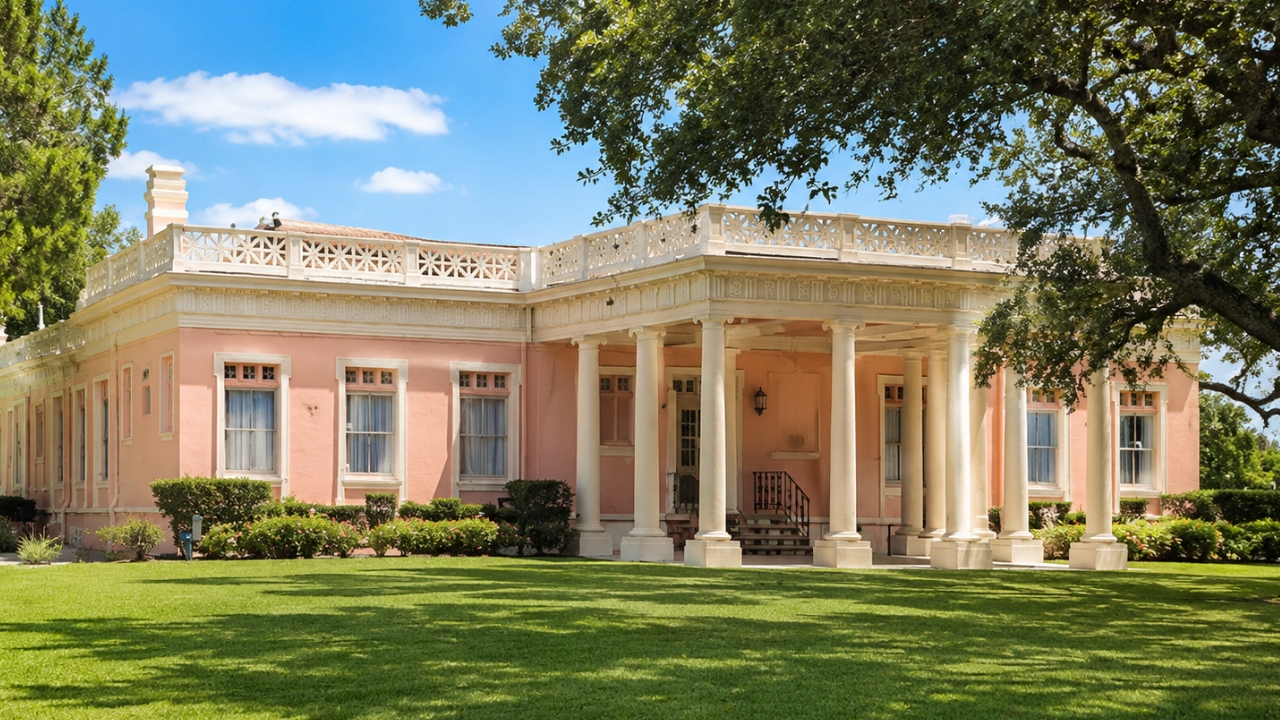
It is a real Texas landmark sitting at 1953 Lakeshore Drive in Port Arthur, built in 1900 and designed to resemble an ancient Roman villa from Pompeii. The Museum of the Gulf Coast says the home was designed by Chicago architects George C. Nimmons and William K. Fellows for Isaac Elwood, a businessman connected to the barbed wire industry.
That alone gives the place a Texas-sized backstory.
At the turn of the 20th century, barbed wire was not just fencing. It was big business. Across the country, open ranges were being divided, ranch land was changing, and fortunes were being made from the products that helped reshape the West.
Elwood had the villa built for more than $50,000 at the time, according to the Museum of the Gulf Coast. The museum notes that would be roughly $1.4 million in modern value.
But the home’s story became even more unusual after that.
Elwood never actually lived in the house, and nothing inside belonged to him. Over the years, the property changed hands several times. One of its best-known chapters involves George M. Craig, who helped organize Texaco. According to Visit Port Arthur, part of the home’s history includes a trade involving stock in the newly formed Texas Company, which later became Texaco.
That is why the home has sometimes been called the “Billion Dollar House.”
The building itself is part of the appeal. The villa has 10 rooms arranged around a traditional Roman-style peristyle, a three-sided courtyard with access from the rooms. It is the kind of architecture most Texans do not expect to find tucked away in Port Arthur.
The house eventually sat vacant before the Port Arthur Historical Society purchased it in 1973, according to the Museum of the Gulf Coast. It later received an official Texas Historical Marker and became part of the region’s historic and cultural identity.
The current renovation effort has been about protecting that history.
Chron reported that museum staff removed nearly all of the century-old furnishings before the work began so the most valuable pieces could be protected offsite. Those furnishings have since been returned as crews finish the final phases.
The museum’s website still lists the Pompeiian Villa as closed for scheduled renovations and says it looks forward to reopening the improved facility. No exact public reopening date has been announced yet, but museum staff have said a grand reopening will be announced when the villa is ready.
That is good news for Southeast Texas history lovers, road-trippers, architecture fans, and anyone who enjoys visiting places that do not feel like every other stop in the state.
Texas has plenty of famous destinations, from the Alamo to Big Bend to the Fort Worth Stockyards. But some of the best stories are tucked into places people overlook. The Pompeiian Villa is one of those places: part oil-boom history, part Roman-inspired architecture, part Port Arthur landmark.
For now, visitors will have to wait a little longer before stepping back inside.
But after a long stretch of repairs, Texas’ own little piece of Pompeii appears to be getting closer to its public return.

Grady Howard contributes coverage on Texas public-interest stories, household costs, transportation, weather-related concerns, safety alerts, and consumer topics.
His reporting is built around practical context — what changed, why it matters, and what readers should pay attention to next.